Tulips

Tulips

Friday, May 4, 2012

Plants You Can't Do Without - Part 3

My trees will arrive on Tuesday. In the meantime Let's get back to those wonderful plants you just can't do without. For me, one must have peonies! They are the ideal herbaceous plant, beautiful and fragrant while blooming, forming a lovely low green hedge when the flowers are done, and then when you need a place to scoop the snow, they die back until next year. Add the fact that these plants will live over 100 years, and you get the idea why you must have some.
When I was growing up in western Nebraska, we had a row of peonies along our back yard fence. Peonies were the preferred flower for "Decoration Day" (or Memorial Day for the rest of the country). My family would go to the cemetery at Trenton and "decorate" the graves of the Campbell forebears. My great-grandfather was a Civil War veteran, and so we remembered and honored him. It was always a race with the peonies, however. Would they open in time? We would go out on May 29 and look at the ants crawling over the still unopened buds and encourage them along. If a little warm weather came along, we were golden. Usually though, my mother would go to Skinny Anton's grocery store the night of May 30 and buy peonies that had been shipped in from warmer climates (eastern Nebraska, I expect.)  Here in New Hampshire the peonies don't bloom until mid June. 
All peonies are beautiful, but my favorites are the Japanese peonies. These aren't the old fashioned bombs that you have to stake for fear of them falling down at the first hint of a shower. They have a single row of petals with the fringey pom-pom in the center (I'm sure it has a name). The best can grow 6-8" wide.
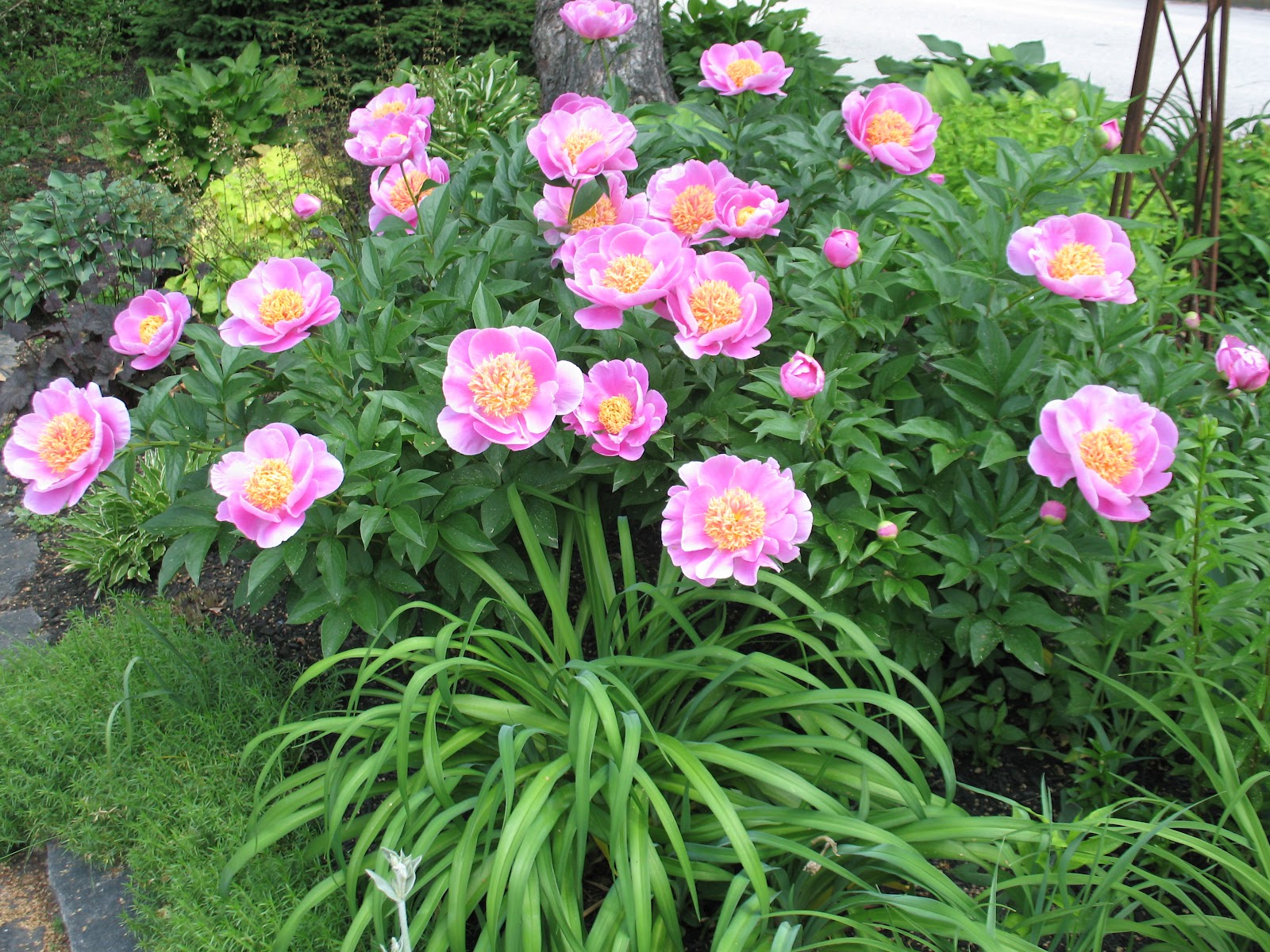
For the last 15 years I have been welcomed at the beginning of summer by the wonderful deep pink blooms of Paeonia "Bowl of Beauty". Three plants grow in the little peninsula next to the street at my house, and cheer all who drive or walk by. They must present over a dozen flowers apiece. Their pink, tipped with gold, frilly centers seem to glow on a cloudy day. If the weather stays a little cool, they last and last. Although they make beautiful cut flowers, the fragrance can be so overwhelming, you may want to move out of the house if you bring them in for an extended time.

These wonderful perennials should be planted in the fall. Make sure you find the right place because they don't much like being moved. Plant with sufficient compost and be patient. Peonies take two or three years to really get going. The roots have little red "eyes" that you don't want to plant too deep, or you will never see any flowers. Just read the instructions and you will be fine. I have also noticed that peonies don't like to be smothered in mulch, so just take it easy and you will have a display fit for an emperor.


Sunday, April 22, 2012

Let's Get Gardening

As so many of you across the country may know, spring has come very early here in New England. A riot of blooming trees and shrubs are exploding all around us. The flowering crab apples are the latest to present themselves in my yard. The Dr. Merrill magnolias are long gone. My single redbud that I grew from a whip finally is covered in little hot pink buds for the first time ever. The PJM rhododendrons are in their full fuchsia exuberance. Tulips are on the heels of the daffodils, and the shad are blooming on the edges of the pink tinted maple forest.
This is one of my favorite times of year. The fuzzy forest green still allows you to peer through the branches to the scenery beyond. Even the most humble of tree and shrub is decked out with the most ornate  jewelry to attend its yearly mating dance. Once again we inhale the fragrance of spring, and, full of promise, head out to the garden.
This year I was able to get a head start on so many fronts. I was out digging up dandelions and thinning my raspberry canes. Let me add this confession; I am not a hard worker in the garden. I love to sit in the sun and enjoy the view. I also like to spend my time outside walking around imagining what improvements I will make that year. So you see, ther is little time for actually doing the work that the garden requires. Fortunately I have a dedicated and talented gardener, Joel Faucher, who comes in the spring and rakes and fertilizes and sows grass seed where necessary. Her is a link to his website. http://livityearth.com/index.html You will be able to see a few views of my yard artfully presented.
 I stopped by a local discount store last week and found that they had received a shhipment of shrubs. This can be a wonderful find if you get them fast before the good ones are gone or befor the untrained sales staff has had a chance to kill them. I located the last five boxwood - just the number I need to finish my allee. They also had the hard to find De Groots Spire arborvitae. I snatched up 7 of these young shrubs for $5 each. I think that I will replace the yews in my allee with arborvitae as the deer think the yews are too tasty a snack. Will move yews closer to the house where they may stand a better chance. Next time I will tell you about my plans for planting trees this year.

Thursday, March 29, 2012

travels to the Midwest

I have just returned from Nebraska. Drove from east to west along the Platte River. The plains are a beautiful sight - all of that grass and BIG SKY. I wanted to share my photographs with you from the Lauretzen Gardens in Omaha. These gardens lie on the bluffs overlooking the Missouri river. The bluffs are so interesting, take time to read about the loess soil that blew in aeons ago. In some places the soil is 20 feet deep. Hope you enjoy the slide show. Here is the website for the gardens.

here is the slideshow:


Sunday, March 4, 2012

Long time gone

If you are following my blog you may have noticed the dearth of posts since Christmas. I have been taking a class in site engineering from the Landscape Institute at the BAC. http://www.the-bac.edu/education-programs/the-landscape-institute It is a wonderful program for landscape enthusiasts and professionals.Site engineering has answered so many questions I have had about grading landforms and controlling storm water runoff. I now know how to calculate slopes and design a traverse sloping path.
 This is the third course I have taken from the LI and I can't believe how much I have learned. I thought I might share a few pictures of my work:

Geomorphic Land Form Design
The object of this design was to design a gathering space that you could reach by two different paths, AND you had to do it all by manipulating contours - no stone paths or hedges or perennial borders, just grass, retaining walls, and rain gardens (areas that catch rainfall and have wetlands planting.) My charge was to come up with a geomorphic solution to the problem; that is to have spaces defined by angled lines and crystalline shapes. There are two paths to the space. One hugs the side of the mound that creates the gathering space and the other path forms a ridge that is surrounded by rain garden. Both paths have a slope of 5% or less in order to be handicapped accessible. A small retaining wall serves as a bench where one may rest and take in the larger view beyond. The slopes of the predominance of land forn is 2:1, which accentuates the shapes of the land. All in all I think you are looking at 20-30 hours worth of work to design, work out all the kinks and build the model. One sheet of cardboard represents on foot of elevation change. the rain garden is represented by dried oregano glued down. This model smells quite a bit like a pizza.
Design for a Music Center Landscape in Geometric Form

Street View
This next model is one of my favorite designs. I participated in a steering committee in my town that was looking at re-use of National Guard Armory property. One idea was to turn the brick vehicle storage building into a performing arts center. (Just last week I read in the paper that a few local people have applied for a grant to actually accomplish this.) I , however was thinking more about the gathering space in front of the building and how it related to the street. In my design there is a brick terrace, with an allee of honeylocusts (Gleditsia) creating a formal promenade in front of the building. The space is bounded but easily penetrated by staggered rows of formal clipped arborvitae (Thuja). The model is made of dried sedum flowers, dried astilbe, and little pieces of black foam board.
Proposed Naturalistic Park for Evans Flat

Street View
These two pictures are of a design for a small park along the road where I usually walk my dog. it borders an extensive wetlands at one end, and is now usedby the town as a place to dump snow. There would be a path for walkers and joggers, and native shade trees that tolerate moist soils would be planted. These consist of the magnificent Liquidambar (sweetgum), that has a starshaped leaf and a brilliant red fall color It grows 60-75 feet tall and 40 feet wide. and the Liriodendrope (tulip tree), another large tree with tulip shaped flowers in the late spring, and nice yellow fall color. Added to those trees I would have a grove of Nyssa sylvatica (black tupelo) a beautiful smaller tree with gray bark and red to purple fall color. The yellow plants in the front of the picture represent the Magnolia virginiana, with lemon scented yellow flowers and large dark green leaves. Birch trees with white bark would be placed against the backdrop of hemlocks and pines that have been growing naturally in the wetlands buffer. the white area on my model would be mown grass. i would also have drifts of Clethra (summersweet in the background), a beautiful sweet scented shrub that grows 6-10 feet tall, and blooms in the summer.

So, I hope you have enjoyed reading a little about my projects, and remember March, In like a lion, out like a lion! That is if you live in New Hampshire. Still even here the hounds of spring are advancing. Happy garden dreaming on these snowy days.

Saturday, December 17, 2011

A December Walk

One of the wonderful things about living in a small town is that you can take a walk any time and see what the neighbors are up to in their gardens. December may seem like an odd time to be looking at landscapes, but it is a good time to observe the structure of a landscape without being overly dazzled by the flowers' siren song. It was a bright sunny afternoon, and I made this slide show to show you some of my favorite sites and some of the missed opportunities in people's yards. Just click on the title below.

Around Town

Note: The slide show sets at 3 seconds, but you will probably need to adjust for a longer viewing time to read the captions.

Sunday, November 27, 2011

Plants You Can't Do Without (continued)


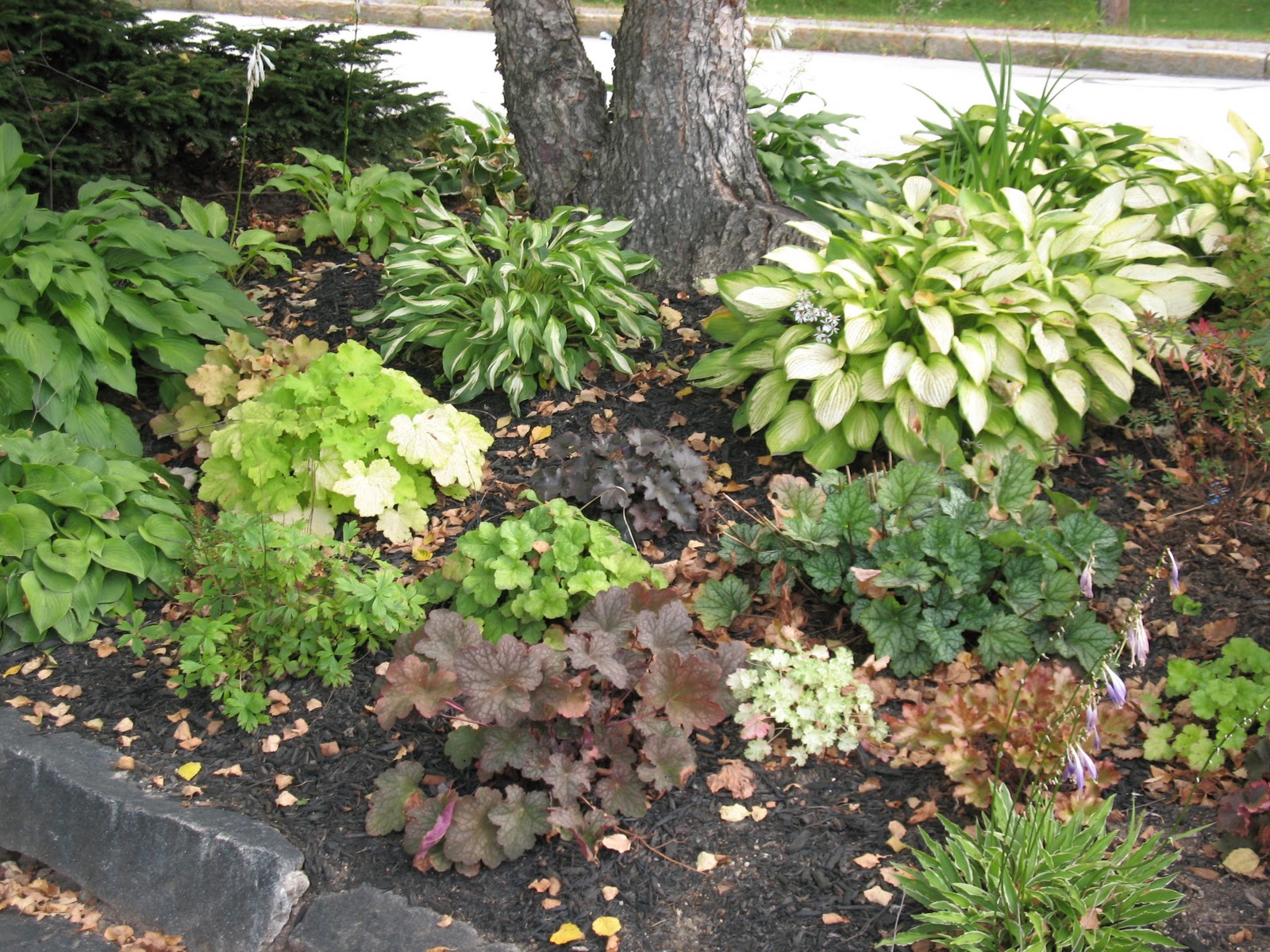
Heuchera planted with hosta under the birch tree,
You get an idea of the variety of color and texture.


White Coral Bells
Upon a slender stalk,
Lilies of the Valley
Deck my garden walk.

Oh, don't you wish
That you could hear them ring?
That will happen only
When the fairies sing.

I remember this song from childhood, but not until many years later did I re-discover this most useful garden plant. Heuchera is its Latin name. Native to North America, it is a semi-evergreen perennial that grows happily in between sun and shade. It is low in habit and makes a beautiful ground cover.

Not all of the bells are white, or coral for that matter. I have Heuchera with flame red bells others pale pink. But really the biggest color punch comes from the foliage and not the delicate flowers at all. They have been hybridized in recent years to have foliage as varied as lime green, dark maroon, caramel, peach, yellow, soft green with white striations, and bright raspberry. The great thing about having such beautiful foliage is that the plant always looks good, not just when it is in bloom. Add the fact that the leaves stay good looking well into the fall and....well, a near perfect plant.

Heuchera leaves and flowers make quite beautiful small floral arrangements. They last and last as cut flowers and leaves. mix them with bright colored flowers for pizazz or use soft pinks and creams for delightful delicacy.

Heuchera stay in a nice clump and don't go gallivanting about the garden. The only drawback is that I haven't been able to divide a single plant so far. I just go buy more wonderful Heuchera when I need them. I think that it would be lovely to have them planted in a mass of all one variety, but I just don't have the discipline. Instead I am a "collector", with a jumble of colors together.


Saturday, November 26, 2011

Plants You Can't Do Without

Last week Joel came with a Bobcat and we moved one of my three giant arborvitae (Thuja "Atrovirens") in order to save it from my neighbor's snowplow. (That subject is a post for another day.) They are such beautiful trees, they deserve the attempt. "Atrovirens" is described as fast growing to 30' high and 12' wide. Hardy to Zone 4, it is a beautiful evergreen with pyramidal shape and uniform growth, just great for a tall screen where you don't have a lot of room.


In the past I have been quite dismissive in my attitude toward the lowly and overused arborvitae. As is the nature of snobs, I failed to overlook all of the many fine qualities of the plant. Seeing them shoved up against a house flanking either side of the entrance, the arborvotae is hardly ever shown to its advantage. For those of us in Zone 5 (or 4) the arborvitae is a plant you just can't do without.
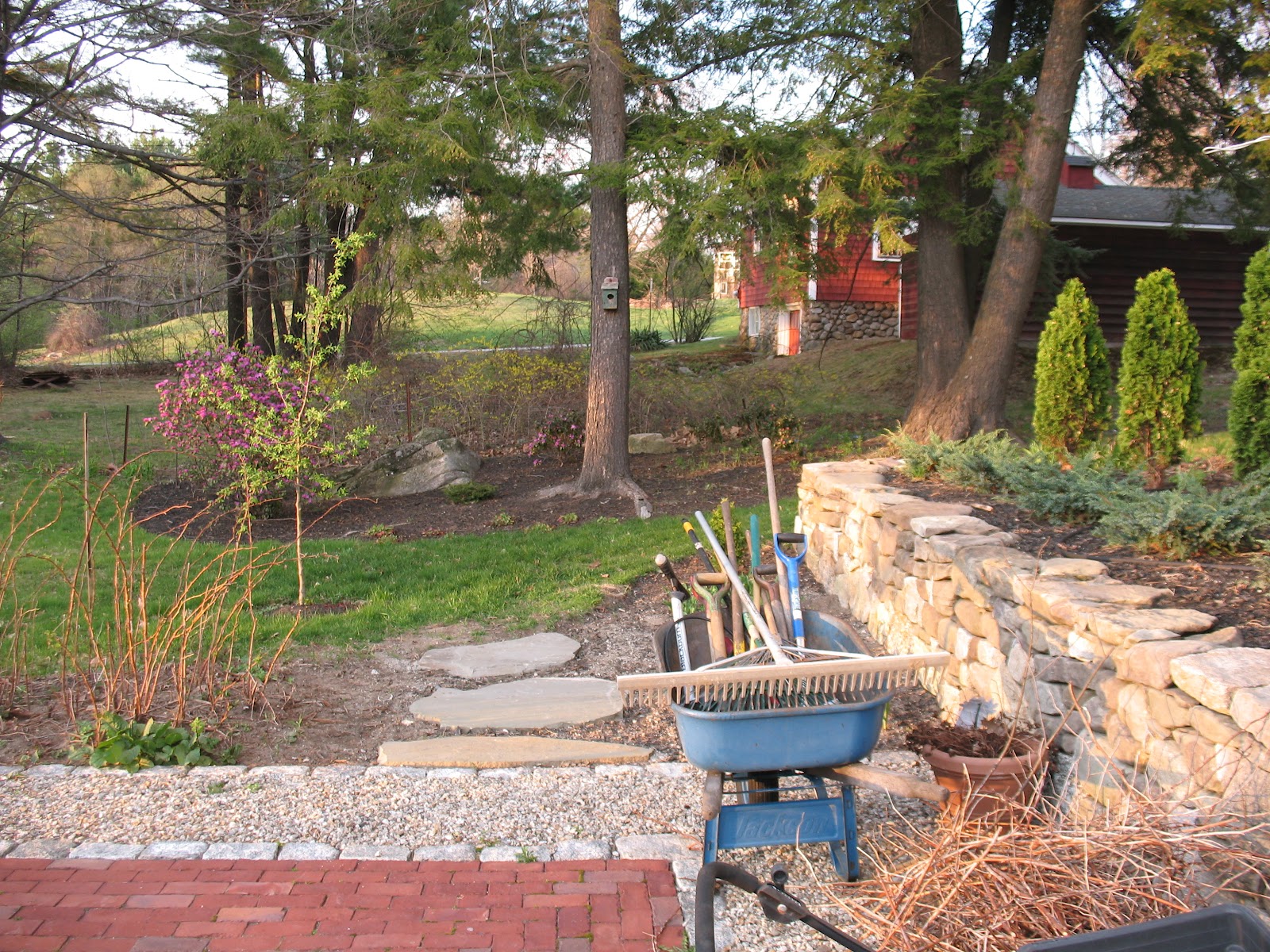
In my travels I have loved the cypresses of Italy and have enjoyed seeing their pointy green profiles in the landscapes of Arizona and Washington State. But alas, cypresses don't grow here. What to substitute for those wonderful green excalmation points? Enter the arborvitae. Another especially beautiful one that doesn't grow quite so large is the Thuja occidentalis "DeGroot's Spire". It is a narrow green pyramid with twisted green fan-like foliage. It grows to be about 15-20' high and 3-4' wide. All of those wonderful Italian allees that you have been dreaming about are there for the making. I have planted four along my stone wall at the back of my house.

Even the lowly Thuja "Smaragd", also know as Emerald Green arborvitae has been planted in mass quantity behind my magnolias in order to give a green backdrop to the lovely white, early spring blooming flowers. I found these little trees at Lowes for a very reasonable price last spring. So remember, It is not always the flashiest plant that makes a good design and a beautiful yard. Don't overlook the usefulness of the arborvitae. (Next blog we will continue to look at another plant you can't do without.)